
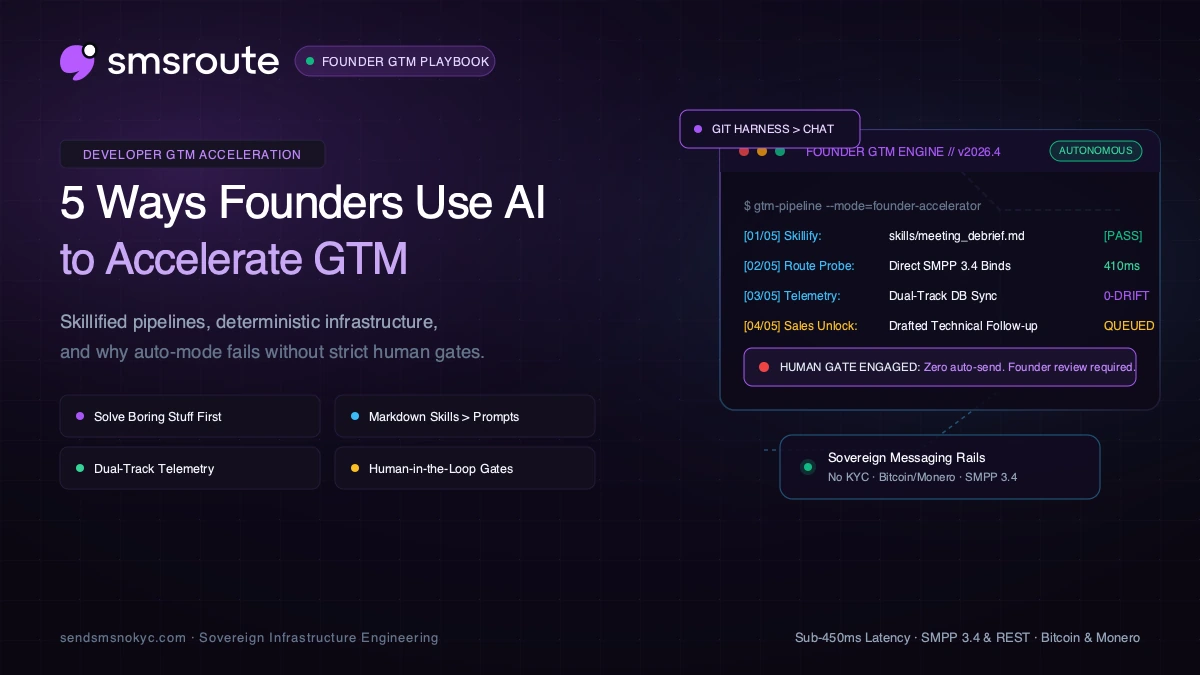
The Infrastructure Founder's Dilemma in 2026
Building a developer infrastructure or API company in 2026 is fundamentally different from building a traditional B2B SaaS tool. When you are operating sovereign messaging pipelines, carrier routing algorithms, or SMPP 3.4 telecommunication sockets, your users are technical engineers who possess an instantaneous radar for marketing fluff and superficial AI slop.
Yet, early-stage technical founders face brutal go-to-market (GTM) friction: managing route delivery failure alerts, monitoring carrier spam filter changes, onboarding enterprise developers who need custom cURL examples, reviewing billing discrepancies, and conducting high-touch technical discovery calls.
Many founders fall into the trap of attempting to build an all-singing, all-dancing autonomous GTM machine on day one—or worse, flooding LinkedIn and GitHub with synthetic AI articles that erode their engineering credibility. As operating partner Austin Hay recently observed across high-growth portfolios at Khosla Ventures, Ramp, Notion, and Replit: "All the stuff that's boring is the stuff you should solve first with AI, not the stuff that's hard."
Here is the technical playbook for how top infrastructure founders are actually deploying AI in 2026 to achieve 10x GTM acceleration without adding corporate headcount.
"All the stuff that's boring is the stuff you should solve first with AI, not the stuff that's hard. Start with the discrete administrative tasks that aren't probabilistic. Those are actually things where you get massive time back."
Rule #1: Solve Boring Deterministic Work First (Stop Generating Content Slop)
The biggest mistake founders make when adopting AI in GTM is starting with content generation. The logic seems enticing: prompt an LLM to generate 50 SEO articles per week and wait for inbound developer signups.
In reality, this produces what the developer community rightfully despises: AI slop. When senior systems architects see generic, hallucinated explanations of SMPP bind types or superficial SMS pricing summaries, they bounce immediately. As Hay bluntly puts it: "If AI were good at writing really good content, we wouldn't see so much slop on LinkedIn right now." Authentic developer content must come from first-principles engineering experience. Write your core architecture posts and benchmark whitepapers from the heart; only bring AI in afterward for syntax checking, schema markup, and copy editing.
Where AI delivers exponential leverage is in boring, discrete, deterministic administrative tasks. In telecommunications and developer API operations, this includes:
- Carrier DLR Reconciliations: Automatically parsing webhook delivery receipts across
upstream carrier routes and clustering error codes like
UNDELIV / 0x0000000B. - HLR Lookup & List Hygiene: Filtering out invalid landlines, disconnected numbers, and VoIP ranges before bulk dispatch to save customer balances.
- Balance & Crypto Settlement Monitoring: Detecting low credit balances and issuing automated 0-conf Bitcoin Lightning top-up invoices.
- Support Ticket Triage: Extracting message IDs, source IP addresses, and destination country codes from developer bug reports before routing them to on-call engineers.
# Example: Deterministic Carrier Error Categorization Skill
import json

def triage_delivery_failure(dlr_payload: dict) -> dict:
    '''Categorizes upstream carrier failure without LLM hallucinations.'''
    err_code = dlr_payload.get("err")
    stat = dlr_payload.get("stat")

    if stat == "UNDELIV" and err_code in ["001", "002", "003"]:
        return {
            "severity": "CRITICAL_ROUTE_DEGRADE",
            "action": "AUTO_FAILOVER_CARRIER_BIND",
            "notify_founder": True
        }
    elif err_code == "004":
        return {
            "severity": "RECIPIENT_HANDSET_OFF",
            "action": "QUEUE_RETRY_BACKOFF",
            "notify_founder": False
        }
    return {"severity": "LOG_ONLY", "action": "STORE_TELEMETRY"}
Rule #2: Skillify First, Automate Second (Git as the Harness)
The foundation of modern developer GTM is that every role at a company is a collection of
skills. A "skill" is not a fuzzy conversational prompt; it is a structured markdown file
(SKILL.md) that describes a precise job to be done, its inputs, verification criteria, and expected
output schemas.
The golden rule for technical founders is: Skillify first, automate second.
- Do it manually 5 to 10 times: You cannot instruct an agent to triage customer SMPP binds or qualify enterprise developer leads until you have experienced the friction and edge cases yourself.
- Codify into a markdown specification: Document the exact steps, context files, and failure
modes into a
SKILL.mdspec. - Commit to a Git repository: Treat your GTM workflows identically to production code. Git provides the harness: version control, pull requests, diff inspection, and rollback safety.
- Promote to a deterministic runner: Once the skill produces reliable, deterministic results over repeated human inspections, wire it into a background cron or event-driven webhook.
# SKILL: Enterprise Developer Lead Qualification
# Version: 1.2.0 | Harness: Git-controlled

## Context & Purpose
Qualify incoming developer inquiries requesting > 50,000 SMS/day.
Determine protocol fit (REST API vs SMPP 3.4) and geographic destinations.

## Required Input Fields
- `monthly_volume_estimate`: integer
- `destination_countries`: array of ISO country codes (e.g. ["US", "DE", "NG"])
- `use_case`: enum [TRANSACTIONAL_OTP, MARKETING, SYSTEM_ALERT]
- `requires_zero_kyc`: boolean

## Deterministic Verification Rules
1. If `requires_zero_kyc` == True -> Assign to Sovereign Crypto Route (BTC/XMR).
2. If `monthly_volume_estimate` > 100000 -> Recommend SMPP 3.4 Bind over REST.
3. If destination includes 10DLC restricted regions -> Verify toll-free alternative.

## Safety Constraint
- DO NOT send automated outbound emails to the prospect.
- Output formatted brief to `outbox/drafts/{lead_id}.md` for founder sign-off.
Rule #3: Dual-Track Telemetry Architecture (Business Truth vs. Directional Signals)
One of the biggest time-sinks for growth teams is obsessing over minor data discrepancies between systems. The CRM reports 1,420 signups, the payment gateway lists 1,390, and the telecommunications gateway logs 1,405 API keys created. Chasing this 5% variance burns weeks of engineering cycles on zero-value reconciliations.
Elite founders solve this by decoupling their analytics into a Dual-Track Telemetry Architecture:
| Architecture Track | Data Source | Tolerated Variance | Primary Purpose |
|---|---|---|---|
| Track A: Business Truth | Production Database (PostgreSQL / ClickHouse) | 0.00% (Zero) | Audited carrier billing, exact SMPP packet counts, revenue, and crypto balances. |
| Track B: Directional Telemetry | AI Log Analyzers, LLM Summarizers, Scratch DBs | 5.0% - 10.0% | Rapid developer churn detection, route latency trends, GTM funnel momentum. |
When you accept that directional reporting will naturally drift by 5% due to webhook retries, timezone offsets, and client-side drop-offs, your team stops arguing over reporting syntax and focuses on what actually moves the needle: shipping direct routes, cutting delivery latency, and closing enterprise binds.
Rule #4: The Founder-Led Technical Sales Unlock (With Non-Negotiable Human Gates)
In the developer tool and API ecosystem, founder-led sales is the highest-converting GTM channel in existence. Enterprise engineering leads don't want to talk to commission-driven SDRs reading a script; they want to talk to the architect who understands sub-450ms p95 latencies, GSM-7 character encoding, UCS-2 byte segmentation, and carrier failover mechanics.
How does a solo founder or small team handle 20 technical calls a week while writing core infrastructure code? The Meeting Debrief Skill.
- Call Ingestion: A background script ingests the meeting recording or transcript immediately upon call conclusion.
- Architecture Extraction: The skill extracts the prospect's exact stack (e.g. Node.js with Fastify, Python with Celery, or Go with SMPP sockets), target countries, required throughput (TPS), and compliance requirements.
- Custom Code Generation: The skill generates fully working, production-grade cURL, Python, and Node.js snippets tailored to the prospect's exact destination numbers and payload format.
- Draft Follow-Up: A drafted email written in the founder's authentic technical voice is placed into the founder's inbox draft folder within 3 minutes of the call ending.
"AI is not good enough to send emails for you automatically. And founders would be insane to ever let AI send an email to a customer. One bad interaction or hallucinated promise can sink a million-dollar contract."
The Non-Negotiable Human Gate: Never allow an automated agent to push the send button. The founder must review the code snippet, verify the pricing tiers, click send, or make manual adjustments. This maintains 100% authenticity while eliminating 90% of the administrative writing burden.
Rule #5: The Myth of "Full Auto-Mode" & The "Less Is More" Stack
A frequent question from early-stage founders is: "Can't I just flip my entire GTM to auto-mode?"
The reality in 2026 is that full auto-mode is a myth. Autonomous agents operate effectively within tightly bounded sandboxes with deterministic assertions. But market positioning, customer relationship building, and high-stakes infrastructure negotiations require human taste, intuition, and accountability.
When building your AI-accelerated GTM stack, embrace Austin Hay's core mantra: "Less is more, baby." You do not need a bloated stack of twelve different subscription AI SDR platforms. A world-class technical GTM stack consists of:
- Git as the Orchestrator: A single repository containing markdown skill files, prompt schemas, and automated test fixtures.
- Deterministic Event Runners: Lightweight cron jobs and serverless functions (Node.js, Bun, or Python) that execute skills against specific APIs.
- Human Approval Gate: A simple Telegram bot, Slack webhook, or email inbox where the founder
taps
[APPROVE]or[REJECT]before any action touches an external customer. - Sovereign Infrastructure Rails: Permissionless communication APIs that don't block autonomous agent workflows behind 21-day KYC passport vetting or corporate tax registration.
Architecture Pipeline Diagram
The complete workflow diagram below illustrates the 5-stage progression from manual discovery to Git-tracked skills, dual-track telemetry, and founder-supervised dispatch.

Frequently Asked Questions (FAQ)
Why shouldn't founders use AI to write blog posts for developers?
Developers immediately recognize generic, hallucinated AI prose. Publishing low-quality AI slop damages your technical credibility and brand reputation. High-leverage founders write technical deep dives and benchmark analyses themselves, using AI strictly for copy editing, syntax checking, and schema generation.
How do you prevent AI skills from drifting or hallucinating?
By enforcing deterministic schemas, narrow context windows, and Git version control. Test your skills against known unit fixtures, treat skill files like code, and require human review gates before any outbound communication or financial action is executed.
What makes Git better than web chat interfaces for GTM systems?
Web chat interfaces (ChatGPT, Claude web) are ephemeral: context is lost when the browser tab closes, and team members cannot collaborate on the same logic. Git provides pull requests, diff tracking, commit histories, and deterministic rollbacks, allowing your team's collective GTM intelligence to compound permanently.
Why do autonomous developer workflows need zero-KYC telephony?
Autonomous agents operating on cloud infrastructure cannot submit government passports or utility bills required by legacy providers like Twilio. SMS Route provides instantaneous REST and SMPP 3.4 telecommunication rails funded with Bitcoin Lightning, Monero, and USDT, enabling automated pipelines to operate without regulatory friction.
Power Your Developer Infrastructure with Sovereign Rails
Send global SMS in sub-450ms p95 delivery latencies. Zero passport KYC, instant Bitcoin & Monero pay-as-you-go funding, and direct SMPP 3.4 binds built for autonomous agent fleets and technical engineering teams.