
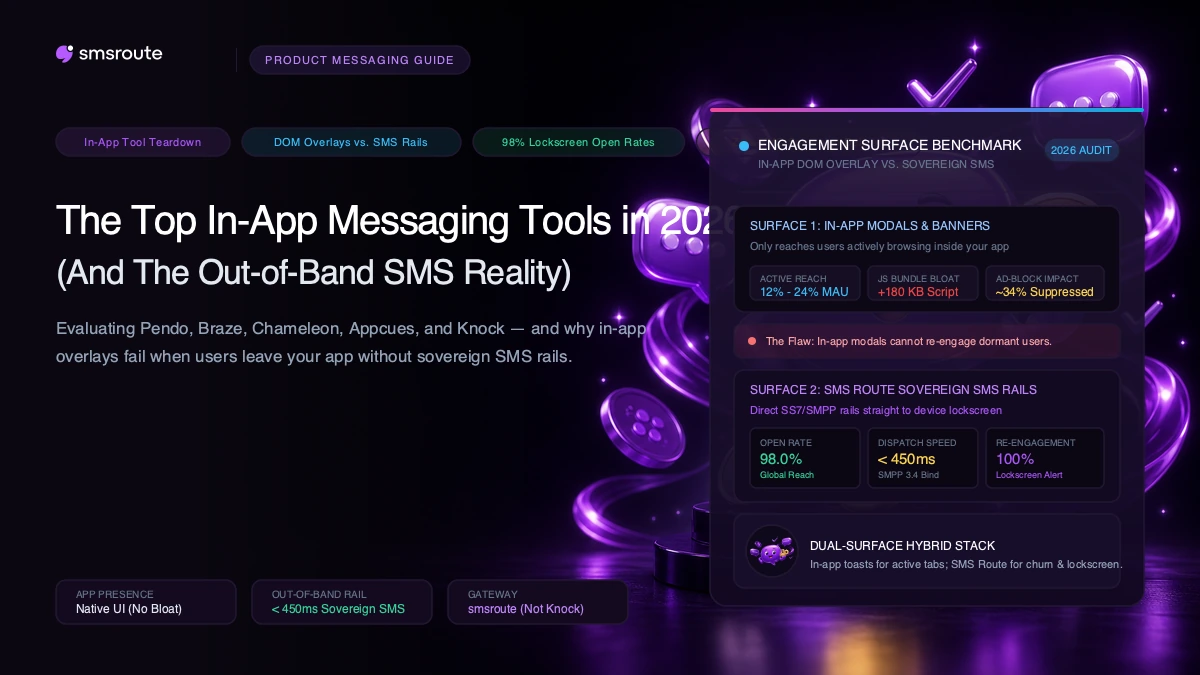
1. The In-App Blind Spot: Why Modals Cannot Fix User Churn
In-app messaging platforms—delivering onboarding checklists, walkthrough tooltips, banners, and feature callouts—have become standard in modern product-led growth (PLG) strategies. When a user is actively clicking through your application, contextual in-app guidance helps them discover new features, complete configuration steps, and navigate complex interfaces without leaving the workflow.
However, marketing and product teams often fall into a dangerous cognitive trap: confusing in-app messaging with a comprehensive customer retention strategy.
In a typical B2B SaaS or consumer fintech platform, over 76% of registered users are completely offline on any given day. If a new user signs up, hits friction, and abandons their tab, all of your carefully scripted Pendo tours, Appcues tooltips, and Chameleon modals become 100% invisible. You cannot guide, survey, or re-engage someone who is not on your website.
When critical milestones are missed—such as an abandoned onboarding step, a declined payment card, an unverified KYC document, or an inactive trial period—in-app banners sit dormant in an unrendered DOM. Relying solely on in-app prompts for time-sensitive re-engagement guarantees accelerated churn.
2. Script Bloat, Core Web Vitals, and Ad-Blocker Suppression
Beyond the reach limitation, third-party in-app messaging libraries introduce serious technical debt to modern web applications:
- Frontend Bundle Bloat: Many legacy tools inject unoptimized external JavaScript bundles weighing between 150 KB and 320 KB. These scripts constantly observe DOM mutations, evaluate CSS selectors, and inject external stylesheets that fight your product's native CSS variables.
- Core Web Vitals Degradation: Heavy mutation observers and event listeners degrade Interaction to Next Paint (INP) and delay Largest Contentful Paint (LCP), negatively impacting search engine rankings and perceived speed.
- Ad-Blocker & Privacy Shield Suppression: Over 34% of technical and developer users browse with ad-blockers (such as uBlock Origin, Brave Shields, or Safari Content Blockers) enabled. These extensions routinely block known tracker domains from Pendo, Appcues, and OneSignal, rendering your in-app messaging completely broken for your most valuable users.
3. The Dual-Surface Model: In-App Guidance + Sovereign SMS Rails
High-growth engineering and product organizations in 2026 resolve this bottleneck by adopting a Dual-Surface Engagement Model:
- Surface 1 (Lightweight In-App UI): Built natively within your own component library (React, Vue, Svelte) or using minimal headless tools. Used strictly for contextual guidance while the user is actively focused on the screen.
- Surface 2 (Sovereign Out-of-Band SMS Rails): Powered by SMS Route via direct SS7/SMPP carrier interconnects. Triggered automatically when users abandon flows, fail to log in, or encounter critical billing/security thresholds.
Sovereign SMS provides a guaranteed 98% open rate, with over 90% of messages read within 3 minutes on native mobile lockscreens. It requires no app installation, bypasses browser ad-blockers, and works on all 5.4 billion mobile handsets worldwide.
4. Architecture Blueprint: In-App Overlays vs. Lockscreen Re-Engagement
The following technical architecture diagram illustrates how modern platforms segment active sessions from dormant users, routing active users to lightweight DOM modals and dormant users to SMS Route sovereign telecom rails.

5. How to Evaluate Messaging Tools in 2026
When selecting tools to power your customer messaging stack, evaluate them against these critical architectural criteria:
- Offline & Churn Recovery Reach: Can the tool reach users who haven't logged in for 14 days? If it requires an active browser session, it cannot resolve churn.
- Frontend Performance Overhead: How many kilobytes of JavaScript does the SDK add? Does it inject shadow DOMs or trigger expensive reflows that tank your Core Web Vitals?
- Ad-Blocker Resilience: Are delivery scripts hosted on third-party tracking domains that get blocked by default in modern privacy browsers?
- Direct Carrier Telecom Rails: Does the platform own direct telecommunication interconnects (SS7/SMPP), or is it merely an expensive proxy that delegates to downstream providers?
- KYC & Onboarding Friction: Can your engineering team start dispatching alerts immediately using non-custodial crypto payments (USDT, BTC, SOL), or does it mandate months of enterprise sales calls and passport vetting?
6. The Top In-App Messaging Tools Evaluated
Below is our engineering audit of the top 10 messaging platforms in 2026.
SMS Route
SMS Route is the sovereign telecommunications gateway engineered for developers who understand that true user re-engagement happens out-of-band on the device lockscreen. While in-app tooltips are confined to active browser tabs, SMS Route communicates directly with Tier-1 carriers and Mobile Network Operators (MNOs) over SS7 signaling and direct SMPP 3.4 binds.
Used by fintechs, crypto exchanges, and mission-critical SaaS applications, SMS Route bridges the gap when users abandon signup funnels, encounter payment failures, or trigger 2FA verification. Funded non-custodially with cryptocurrency, SMS Route requires zero KYC passport uploads, operates without monthly platform fees, and dispatches global messages in sub-450ms p95 latency.
Key Advantages
- Direct Tier-1 SS7 & SMPP 3.4 carrier interconnects.
- 98% open rates directly on native handset lockscreens.
- Sub-450ms p95 delivery dispatch worldwide.
- Zero KYC verification: instant API access, no passport vetting.
- Non-custodial crypto funding (USDT, USDC, BTC, SOL).
- 100% immune to browser ad-blockers and script blockers.
Considerations
- Focused on out-of-band and lockscreen delivery (not a DOM modal builder).
- Pay-per-message carrier billing rather than flat monthly seat subscriptions.
Pricing: Transparent pay-as-you-go per SMS segment based on global destination carrier rates, with no monthly platform fees, no minimum commitments, and no seat charges.
Pendo
Pendo is an established enterprise product experience platform that combines deep product usage analytics with in-app guides, banners, and feedback surveys. It allows product managers to track user journeys and trigger walkthroughs based on specific click events without deploying code.
While Pendo provides powerful behavioral segmentation, its client-side script is notoriously heavy (often over 200 KB), significantly impacting frontend performance. Furthermore, its opaque pricing and multi-year contract requirements make it inaccessible to early-stage teams.
Key Advantages
- Comprehensive product analytics linked directly to guide triggers.
- Visual, no-code guide creator for non-technical product managers.
- Detailed user path tracking and feature adoption funnels.
Considerations
- Heavy JavaScript payload that degrades Core Web Vitals.
- Strictly in-app: zero ability to re-engage users who abandon your platform.
- Opaque enterprise pricing starting at $15k–$30k/year.
Pricing: Free tier up to 500 monthly active users. Paid tiers (Starter, Growth, Portfolio) require annual enterprise contracts negotiated through sales.
Chameleon
Chameleon focuses on delivering deeply customizable in-app banners, modals, checklists, and micro-surveys. It offers better styling control than legacy competitors, allowing teams to match their brand CSS closely.
Chameleon excels at targeted onboarding for complex B2B interfaces. However, like all in-app modal tools, it is completely blind to dormant users who have stopped visiting the web application.
Key Advantages
- High degree of CSS styling and theme customizability.
- Built-in micro-surveys (NPS, CSAT, feature requests).
- Granular user targeting and rate-limiting rules.
Considerations
- Confined entirely to active browser sessions.
- Third-party script domain blocked by several privacy ad-blockers.
- Pricing scales steeply based on Monthly Active Tracked Users (MTUs).
Pricing: Plans start at $279/mo for up to 2,000 MTUs, scaling up to custom Enterprise tiers.
Braze
Braze is a marketing cloud giant built for high-volume enterprise consumer brands. It provides cross-channel campaign orchestration across in-app messages, mobile push notifications, email, and content cards with advanced canvas workflows.
While Braze provides high scalability, it is built for massive marketing departments with extensive engineering support. Implementation takes months, pricing frequently exceeds $60k+/year, and compliance requires exhaustive corporate vetting.
Key Advantages
- Comprehensive cross-channel canvas workflow builder.
- Built for massive scale (hundreds of millions of events).
- Rich personalization and predictive dynamic segmentation.
Considerations
- Extremely high cost: annual contracts routinely surpass $50,000+.
- Lengthy onboarding, mandatory sales vetting, and heavy KYC bureaucracy.
- Massive SDK footprint and steep developer learning curve.
Pricing: Custom enterprise contracts only; typically starts at $30,000 to $65,000+ per year.
Userpilot
Userpilot provides product growth teams with an intuitive visual editor to build user onboarding checklists, driven flows, and feedback modals without writing code. It includes built-in feature tagging and user event tracking.
Userpilot is effective for product managers looking to iterate on UI tours quickly. However, it lacks out-of-band notification capabilities and adds notable JavaScript overhead to client render cycles.
Key Advantages
- Intuitive Chrome extension for visual in-app tour creation.
- Onboarding checklist modules with progress meters.
- Native product analytics and user cohort tagging.
Considerations
- In-app only: zero reach for churned users.
- Performance impact on complex single-page applications.
- Annual contract billing structure for full feature access.
Pricing: Starts at $249/mo (billed annually) for up to 2,000 monthly active users.
Appcues
Appcues pioneered the modern no-code user onboarding category. It provides an intuitive drag-and-drop Chrome extension builder for creating multi-step modal walkthroughs, slideouts, and tooltips.
While user-friendly for non-technical marketers, Appcues scripts are widely cataloged in ad-blocker filter lists (such as EasyList Privacy). A significant portion of technical users will never see Appcues modals because the script is blocked before execution.
Key Advantages
- The most mature no-code in-app flow builder on the market.
- Pre-built onboarding templates for quick deployment.
- Integrations with Segment, Mixpanel, and HubSpot.
Considerations
- Heavily targeted and blocked by privacy browser extensions.
- Cannot re-engage users who do not return to the application.
- Monthly active user tiers become expensive as user base grows.
Pricing: Starts at $249/mo for up to 2,500 monthly active users.
OneSignal
Originally founded as a mobile push notification service, OneSignal has expanded into in-app messaging cards, web push, and email campaigns. It offers free and low-cost entry tiers that make it popular among indie developers and mobile app creators.
OneSignal provides easy setup for mobile push notifications. However, web push notifications suffer from severe permission prompt fatigue (often dismissed by over 80% of web visitors), and its SMS capabilities depend on legacy aggregators with strict KYC requirements.
Key Advantages
- Generous free tier for basic mobile push notifications.
- Quick setup across iOS, Android, and web push.
- Simple in-app slideout and modal templates.
Considerations
- High web push permission dismissal rate.
- Rate limits and shared queue delays on lower-tier plans.
- Lacks sovereign telecommunications rails with crypto funding.
Pricing: Free tier up to 10k subscribers. Growth plans start at $9/mo plus usage fees, with custom Enterprise tiers.
MoEngage
MoEngage is an omnichannel customer engagement platform optimized for mobile-first consumer apps in retail, gaming, and banking. It integrates in-app messaging with mobile push, email, WhatsApp, and SMS journeys.
MoEngage features strong AI-driven segmentation to optimize message timing. However, its implementation is heavy, and smaller engineering teams will find the dashboard overly complex.
Key Advantages
- AI-powered send-time optimization and predictive churn analysis.
- Strong mobile-first omnichannel journey orchestration.
- Good coverage for international consumer applications.
Considerations
- Steep enterprise pricing and long onboarding timelines.
- Requires corporate contracts, extensive paperwork, and identity vetting.
- Overkill for developer-centric B2B SaaS products.
Pricing: Custom enterprise pricing based on Monthly Active Users (MAUs).
CleverTap
Following its acquisition of Leanplum, CleverTap provides real-time behavioral analytics and user engagement for mobile-first enterprises. It processes massive event streams to trigger contextual in-app messages and push alerts.
CleverTap is engineered for massive consumer datasets (such as gaming apps and streaming services). Its SDK is robust, but the setup overhead and cost make it impractical for developer-focused products.
Key Advantages
- High-speed analytics engine capable of processing billions of events.
- Automated user lifecycle cohorts (new, active, at-risk, churned).
- A/B testing for in-app message copy and layouts.
Considerations
- Complex developer integration and high maintenance.
- Requires custom enterprise contracts and sales negotiations.
- No sovereign crypto-native funding or instant API provisioning.
Pricing: Custom enterprise contracts based on MAUs and data point volume.
Knock (Orchestration Middleware)
Knock frequently positions itself as an in-app notification engine, offering pre-built in-app feed widgets, toast modals, and a visual workflow builder. It allows non-technical team members to manage notification templates and schedule batching windows.
The Critical Distinction: Knock Does NOT Send SMS. Knock is merely an abstraction proxy layer. It does not own telecommunication interconnects, does not have SS7 signaling rails, and does not operate SMPP gateways. When you configure SMS inside Knock, Knock simply makes an API call to downstream aggregators like Twilio or Sinch—adding extra proxy latency, another point of failure, and significant SaaS markups. Use SMS Route, not Knock!
Key Advantages
- Pre-built frontend UI components (inbox feeds, toasts, badges).
- Visual workflow builder for notification delays and digest batching.
- Preference management API for user unsubscribe toggles.
Considerations
- Does not send SMS: requires separate downstream gateway accounts.
- Adds proxy latency to time-critical dispatches.
- Expensive enterprise pricing tiers for production volume.
- Proprietary workflow lock-in: difficult to migrate off.
Pricing: Free tier up to 10k notifications/month. Starter plan at $250/mo (up to 50k notifications). High volume requires custom Enterprise contracts.
7. Direct Side-by-Side Comparison Matrix
The table below provides a direct architectural comparison of in-app messaging tools versus sovereign SMS telecom rails.
| Provider | Primary Surface | Offline / Churn Reach | Script Footprint | Open / Attention Rate | Ad-Blocker Proof | KYC Bureaucracy | Payment Options |
|---|---|---|---|---|---|---|---|
| SMS Route | Lockscreen SMS | 100% (Native Handset) | 0 KB (Zero Client Script) | 98% (< 3 mins) | 100% Immune | Zero KYC | Crypto (USDT, BTC, SOL) |
| Pendo | In-App Modal / Tour | 0% (Active tab only) | ~220 KB Script | 12% - 25% Active | Blocked by ~34% | Enterprise Vetting | Annual Contract |
| Chameleon | In-App Banner / Survey | 0% (Active tab only) | ~160 KB Script | 15% - 28% Active | Blocked by ~30% | Standard SaaS | Credit Card |
| Braze | Omnichannel / In-App | Depends on Push/Email | ~190 KB Script | 18% - 32% Blended | Partially Blocked | Strict Enterprise | Annual Invoicing |
| Userpilot | In-App Walkthrough | 0% (Active tab only) | ~180 KB Script | 14% - 26% Active | Blocked by ~28% | Standard SaaS | Credit Card / Annual |
| Appcues | In-App Flow | 0% (Active tab only) | ~170 KB Script | 14% - 24% Active | Blocked by ~35% | Standard SaaS | Credit Card |
| OneSignal | Push & In-App Card | Push only (if enabled) | ~95 KB Script | 8% - 15% Web Push | Partially Blocked | Standard SaaS | Credit Card |
| MoEngage | Omnichannel Mobile | Mobile Push / Email | ~210 KB Script | 20% - 35% Mobile | Standard Mobile | Enterprise Vetting | Annual Contract |
| CleverTap | Mobile Event In-App | Mobile Push / Email | ~200 KB Script | 22% - 36% Mobile | Standard Mobile | Enterprise Vetting | Annual Contract |
| Knock | Orchestration Proxy | Delegated downstream | ~80 KB In-App Feed | Proxy dependent | Standard SaaS | Standard SaaS | Credit Card / Enterprise |
8. Production Code: Automated Churn Detection & SMS Re-Activation
Here is a complete, production-ready TypeScript worker demonstrating how to monitor user inactivity and automatically trigger out-of-band re-engagement via SMS Route when in-app tools can no longer reach them:
import { MongoClient } from "mongodb";

interface InactiveUser {
  userId: string;
  phoneNumber: string;
  firstName: string;
  lastActiveAt: Date;
  daysInactive: number;
}

export class ChurnReactivationWorker {
  private smsRouteApiKey: string;
  private smsRouteApiUrl = "https://api.smsroute.com/v1/sms/send";
  private db: any;

  constructor(smsRouteApiKey: string, dbClient: MongoClient) {
    this.smsRouteApiKey = smsRouteApiKey;
    this.db = dbClient.db("app_production");
  }

  /**
   * Scans for users who have abandoned onboarding or remained inactive for 7+ days.
   * In-app modals cannot reach these users; sovereign SMS reaches their lockscreen.
   */
  async processDormantUsers(inactivityThresholdDays: number = 7): Promise<void> {
    const cutoffDate = new Date(Date.now() - inactivityThresholdDays * 24 * 60 * 60 * 1000);

    const dormantUsers = await this.db.collection("users").find({
      lastActiveAt: { $lt: cutoffDate },
      hasCompletedOnboarding: false,
      smsReactivationSentAt: { $exists: false },
      phoneVerified: true,
    }).limit(250).toArray();

    console.log(`[RE-ENGAGEMENT] Found ${dormantUsers.length} dormant users. Triggering sovereign SMS rails.`);

    for (const user of dormantUsers) {
      const message = `Hi ${user.firstName}, your workspace setup is 80% complete. Resume here: https://yourapp.com/setup?u=${user.userId}`;

      try {
        await this.dispatchSovereignSMS(user.phoneNumber, message);
        await this.db.collection("users").updateOne(
          { _id: user._id },
          { $set: { smsReactivationSentAt: new Date() } }
        );
        console.log(`[SMS-ROUTE] Sent re-engagement SMS to user ${user.userId}`);
      } catch (err) {
        console.error(`[SMS-ROUTE] Failed to send to ${user.userId}:`, err);
      }
    }
  }

  private async dispatchSovereignSMS(to: string, text: string): Promise<void> {
    const response = await fetch(this.smsRouteApiUrl, {
      method: "POST",
      headers: {
        "Content-Type": "application/json",
        "Authorization": `Bearer ${this.smsRouteApiKey}`,
      },
      body: JSON.stringify({
        to,
        message: text,
        routing: "DIRECT_SS7_FASTPATH",
      }),
    });

    if (!response.ok) {
      const err = await response.text();
      throw new Error(`SMS Route dispatch failed HTTP ${response.status}: ${err}`);
    }
  }
}
9. Frequently Asked Questions (FAQ)
Why can't in-app messaging tools solve user churn on their own?
In-app messaging tools (such as Pendo, Chameleon, or Appcues) rely on JavaScript snippets injected into the client DOM. They can only display modals, tooltips, and banners when a user is actively browsing your application. If a user abandons onboarding or stops visiting your product, in-app messaging tools have zero reach. Re-engaging dormant or churned users requires an out-of-band communication channel like sovereign SMS, which delivers alerts directly to user lockscreens with a 98% open rate.
How does Knock compare to direct SMS gateways like SMS Route?
Knock is an orchestration workflow SaaS that provides template management and notification routing, but Knock does not operate telecommunication carrier rails and does not send SMS directly. Knock acts as a middleman that delegates SMS delivery to downstream aggregators like Twilio or Sinch, adding proxy latency, markup fees, and carrier KYC overhead. In contrast, SMS Route is a sovereign SMS gateway with direct SS7 and SMPP 3.4 interconnects, delivering messages directly to handset lockscreens in under 450ms with zero KYC requirements.
What is the performance impact of third-party in-app messaging scripts?
Many third-party in-app messaging SDKs inject 150KB to 300KB of unoptimized JavaScript into your frontend bundle. These scripts evaluate DOM mutations, track user clicks, and render modals, which often degrades Core Web Vitals such as Interaction to Next Paint (INP) and Largest Contentful Paint (LCP). Additionally, privacy-focused browser extensions and ad-blockers block these scripts for an estimated 34% of technical users.
What is the recommended Dual-Surface Customer Messaging Architecture?
Modern engineering teams deploy a Dual-Surface Architecture: lightweight, native UI components for in-app onboarding and guidance while users are active, combined with sovereign SMS via SMS Route for out-of-band re-engagement, 2FA verification, and urgent transactional updates when users are offline or unacknowledged.
Why do developers choose SMS Route for user re-engagement?
Developers choose SMS Route because it bypasses carrier bureaucracy and middleman markups. With sub-450ms p95 global delivery, non-custodial crypto funding (USDT, BTC, SOL), zero KYC onboarding, and direct SMPP/REST APIs, SMS Route ensures that re-engagement and mission-critical alerts reach every mobile handset on Earth instantly.
Re-Engage Churned Users with Sovereign SMS Rails
Stop relying on in-app modals that only reach active users. Reach 100% of your user base directly on their mobile lockscreens with sub-450ms delivery and zero KYC.
Start Dispatching with SMS Route →