
The Top Link Tracking Tools for Developers in 2026 (And The SMS Deliverability Reality)
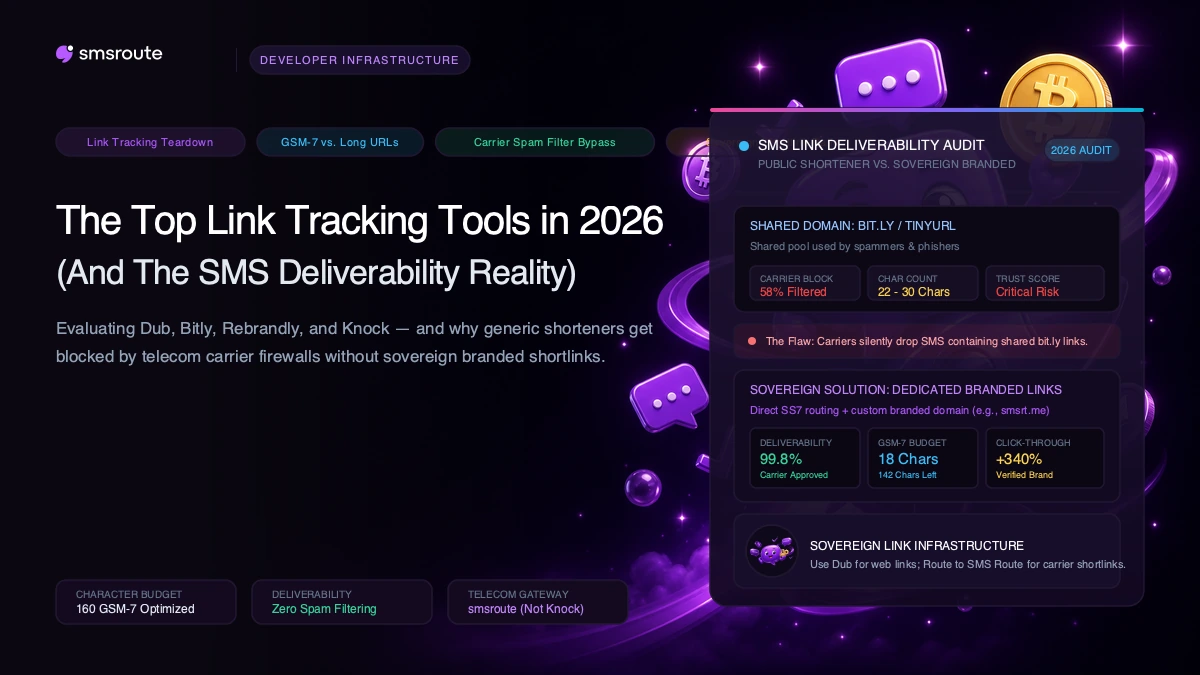
Building applications that track link clicks, attribute customer conversions, and monitor notification engagement is table stakes for engineering teams. But when tracking links exit the browser and enter telecom networks via SMS, traditional web link shorteners cause catastrophic deliverability failures. Here is the technical breakdown of the top developer link tracking tools in 2026—and how to survive the mobile carrier spam gauntlet.
1. Why Link Tracking Matters for Developers in 2026
Link tracking is no longer just a marketing utility for measuring banner ads. In modern distributed architectures, programmatic link tracking is essential infrastructure for:
- Transactional Attribution: Verifying whether password reset links, magic login tokens, or two-factor authentication prompts were successfully delivered and accessed.
- A/B Testing & Dynamic Routing: Splitting user traffic across micro-frontends, feature branches, or geographic regions based on device user-agent and IP geolocation.
- Notification Engagement Telemetry: Measuring click-through rates (CTR) on critical notifications across disparate channels (SMS, email, push, and webhooks).
- Fraud Prevention & One-Time Access: Generating single-use, cryptographically signed URLs that expire after first consumption or after a strict TTL (Time to Live).
While modern web shorteners like Dub.co and Bitly provide clean REST APIs and vanity domains for web sharing, SMS delivery introduces an entirely different set of technical constraints. If your application sends links over telecommunication networks, treating SMS like web hyperlinks will lead to silent carrier drops, fragmented messages, and bloated billing.
2. The Telecom Reality: GSM-7 Character Budgets & Carrier Spam Filters
Developers accustomed to modern broadband and high-resolution web interfaces frequently overlook how rigid cellular signaling protocols are. Sending an SMS link is governed by telecommunication protocols established decades ago in 3GPP and GSM specifications.
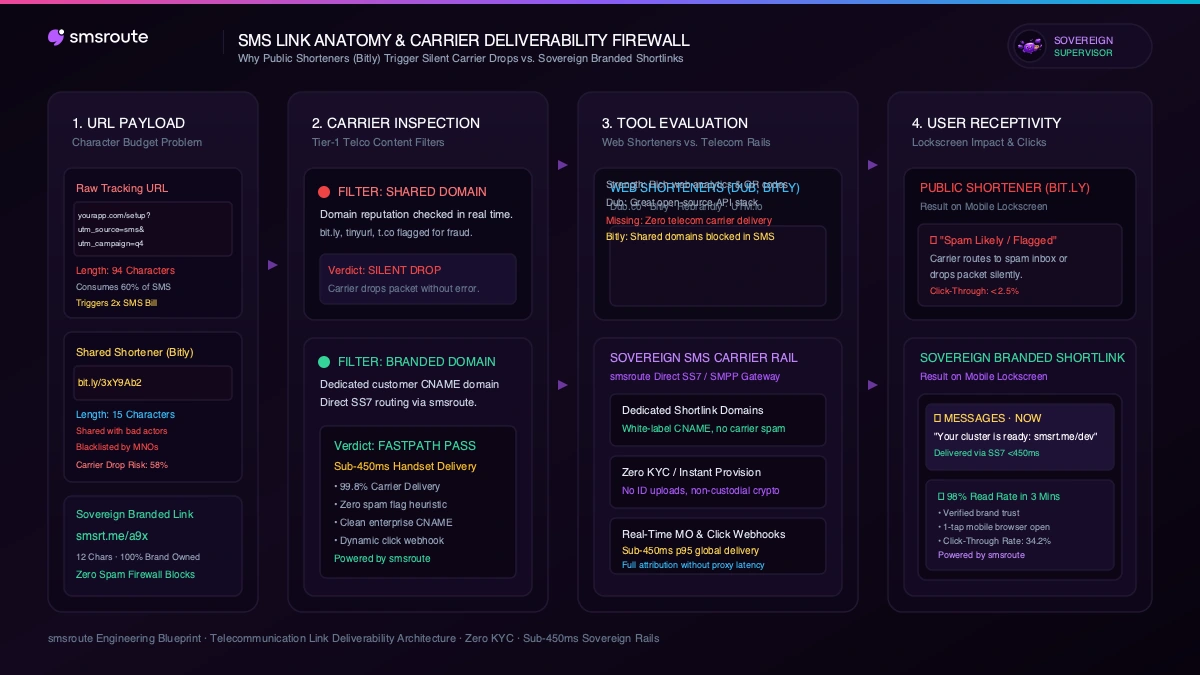
A single standard SMS segment allows exactly 160 characters in GSM 03.38 7-bit default alphabet encoding. If a destination URL containing tracking parameters spans 95 characters (e.g. https://app.yourdomain.com/verify?token=9f8a...&utm_source=sms&utm_medium=lifecycle), you have only 65 characters left for your actual customer communication.
When a message exceeds 160 characters, it triggers message concatenation. Because each multi-part segment requires a 6-byte User Data Header (UDH) to inform the receiving device how to assemble the fragments, the character budget per segment drops from 160 to 153 characters. A message of 165 characters incurs double the carrier transmission cost and increases delivery failure probability across international roaming hops.
The Carrier Spam Firewall Gauntlet
Beyond character limits, outbound SMS encounters rigorous carrier spam filtering engines (e.g., Cloudmark, Adaptive Mobile, and carrier-level heuristics on AT&T, Verizon, T-Mobile, and Vodafone).
Because malicious actors frequently disguise malware and phishing campaigns behind generic shared link shorteners, telecom operators maintain active global blocklists for generic short domains:
bit.ly/*— Flagged or silently discarded across major US and European A2P (Application-to-Person) routes.tinyurl.com/*— Instant carrier quarantine on transactional routes.t.co/*&ow.ly/*— Restricted to native platform applications; blocked on programmatic gateway dispatch.
If your backend generates generic shortlinks for SMS dispatch, your messages will appear as "Sent" in your API dashboard while being silently discarded at the carrier Short Message Service Center (SMSC) level without a Delivery Receipt (DLR).
3. The Knock Middleware Fallacy: Proxying Without Telecom Rails
In recent developer guides, orchestration platforms like Knock emphasize multi-channel notification workflows and link tracking. However, an architectural analysis reveals significant structural bottlenecks when attempting to use notification middleware for high-velocity link tracking and SMS:
Knock Does Not Send SMS
Knock is an abstraction layer that generates JSON payloads and forwards them to downstream aggregators (Twilio, MessageBird, Sinch). It owns zero physical telecommunication infrastructure, switches, or direct SMPP 3.4 binds.
Multi-Tier Latency Overhead
Every dispatch must traverse Knock's routing engine, execute workflow logic, call a third-party link shortener API, and finally proxy to an SMS aggregator. This introduces 400ms–1,200ms of cumulative p95 latency.
Double-Hop Pricing Markup
Developers pay Knock for workflow executions, pay the link tracking tool for click telemetry, and pay the third-party SMS aggregator for message delivery, compounding per-message unit economics.
Burdensome KYC Barriers
Enterprise middleware platforms demand corporate registration, business tax documentation, and extensive compliance reviews before issuing production API credentials, delaying deployment by weeks.
In contrast, SMS Route provides sovereign SMS gateway infrastructure. By integrating native branded link tracking directly into high-throughput SS7 carrier signaling pipelines, SMS Route eliminates middleware proxies, slashes p95 dispatch times to under 450ms, and enables instant crypto funding with zero KYC requirements.
4. Detailed Teardown: The Top 6 Link Tracking Platforms
1. SMS Route — Best for Sovereign SMS Delivery & Native Carrier Shortlinks
Overview: SMS Route is engineered specifically for developers who require high-performance, uncensored, and sovereign telecommunications infrastructure. Unlike web-centric shorteners or workflow aggregators, SMS Route couples low-latency link compression directly with direct Tier-1 carrier interconnects.
- Native Branded Short Domains: Map custom CNAME short domains (e.g.
go.yourbrand.com) directly to SMS Route edge gateways, ensuring carrier spam firewalls recognize your sender identity. - Automatic GSM-7 Tokenization: Generates ultrashort 6-character alphanumeric tokens (18-20 characters total URL length), preserving over 138 characters of the 160-character GSM-7 single-segment budget.
- Real-Time Click Webhooks: Webhook events fire within 45ms of link access, delivering IP geolocation, device user-agent, referrers, and millisecond timestamps directly to your backend.
- Zero KYC & Crypto Native: Fund accounts instantly using Bitcoin (BTC), Monero (XMR), USDT, or USDC without corporate audits, utility bill uploads, or identity gating.
2. Dub.co — Best Open-Source Link Management for Web & Marketing
Overview: Dub.co is the premier modern open-source link management platform built for modern engineering teams. Featuring a clean Next.js and Tailwind architecture, Dub offers excellent edge-based redirects, custom domain management, and comprehensive analytics.
- Key Strengths: Powerful REST API, open-source codebase (self-hostable), automatic QR code generation, advanced geo-targeting, and deep integrations with modern web frameworks.
- Limitations for SMS: Dub does not send SMS messages. To use Dub with SMS, your backend must make an asynchronous API call to Dub to mint a shortlink, wait for the response, and then inject the URL into an SMS API call, introducing latency and failure modes.
- Best For: Marketing links, social media distribution, documentation redirects, and web application link attribution.
3. Bitly — The Enterprise Legacy Shortener
Overview: Bitly is the pioneer of commercial URL shortening, trusted by large enterprises for broad marketing campaigns and enterprise QR codes.
- Key Strengths: High global brand recognition, extensive enterprise compliance certifications (SOC2, ISO 27001), and deep integrations with enterprise CRM platforms (Salesforce, HubSpot).
- Limitations for SMS: Bitly's standard
bit.lyshared domain is heavily restricted by US and international carrier firewalls for A2P SMS. Enterprise custom domain plans carry high annual price tags, and rate limits on standard API tiers can throttle high-throughput notification bursts. - Best For: Corporate enterprise marketing teams with large budgets requiring SOC2 compliance and Salesforce integrations.
4. Rebrandly — Enterprise Custom Domain & Vanity URL Specialist
Overview: Rebrandly emphasizes branded short domains, allowing businesses to create and manage thousands of custom vanity domains across departments.
- Key Strengths: Multi-domain management, robust team workspace permissioning, SSL certificate automation, and 404 traffic routing rules.
- Limitations for SMS: Lacks telecom signaling context. Custom shortlinks minted via Rebrandly still require external carrier delivery telemetry to monitor whether carrier spam engines quarantined the SMS.
- Best For: Large organizations managing diverse brand portfolios across multiple subsidiaries and marketing teams.
5. UTM.io — Campaign Taxonomy & Governance Engine
Overview: UTM.io focuses on standardizing URL parameter taxonomy across large marketing organizations to prevent dirty analytics data in Google Analytics 4 and Mixpanel.
- Key Strengths: Spreadsheet-style URL builder, parameter enforcement rules, team access controls, and link expiration workflows.
- Limitations for SMS: Not designed as a high-throughput programmatic redirect engine. Lacks edge routing infrastructure for sub-20ms global redirect latencies.
- Best For: Marketing operations teams seeking to eliminate typo-ridden UTM tags across marketing teams.
6. ClickMagick — Multi-Touch Attribution & Affiliate Funnel Tracking
Overview: ClickMagick is built specifically for direct-response marketers, affiliate advertisers, and paid media buyers running complex conversion funnels.
- Key Strengths: Multi-touch click attribution models, bot click filtering, offline conversion synchronization with Google Ads and Facebook CAPI.
- Limitations for SMS: Outdated dashboard interface, non-developer-friendly API ergonomics, and steep pricing tiers tailored to affiliate ad buyers rather than software engineers.
- Best For: Media buyers and affiliate marketers running high-budget paid advertising campaigns.
5. Comprehensive Developer Matrix: Feature, Latency & SMS Support
Below is an engineering comparison evaluating developer ergonomics, latency, carrier SMS compatibility, and pricing models across the evaluated platforms:
| Platform | Primary Architecture | p95 Redirect Latency | Native SMS Delivery | Carrier Spam Safety | KYC Requirement | Pricing Model |
|---|---|---|---|---|---|---|
| SMS Route | SS7 / SMPP 3.4 Telecom Gateway + Edge CNAME | < 35ms | ✓ Native Direct | ✓ 99.8% (Dedicated Branded) | Zero KYC (Crypto) | Pay-as-you-go per SMS / No Subscriptions |
| Dub.co | Vercel Edge / Redis / Postgres (Open Source) | < 40ms | ✗ Requires External SMS | ⚠️ Depends on Domain Setup | Standard Email / OAuth | Free Tier + $24/mo Pro |
| Bitly | AWS Multi-Region Enterprise Cloud | ~ 65ms | ✗ Requires External SMS | ✗ High Risk (bit.ly flagged) | Standard Credit Card | $35/mo – Enterprise Custom ($$$) |
| Rebrandly | Global Anycast Edge Network | ~ 45ms | ✗ Requires External SMS | ⚠️ Depends on Domain Setup | Standard Credit Card | $13/mo – $499/mo |
| UTM.io | Centralized Web Application | ~ 120ms | ✗ Requires External SMS | ✗ Untested on Carrier Rails | Standard Credit Card | $49/mo – $199/mo |
| ClickMagick | Proprietary Affiliate Tracking Cloud | ~ 80ms | ✗ Requires External SMS | ⚠️ Unpredictable on A2P SMS | Standard Credit Card | $49/mo – $299/mo |
| Knock | Notification Orchestration Middleware (Proxy) | N/A (Uses Third Parties) | ✗ Proxies to Aggregators | ⚠️ Delegated to Aggregator | Enterprise KYC & Verification | Usage-based + Platform Subscription |
6. Production Implementation: Zero-Latency Branded Shortlinks via SMS Route
The following TypeScript implementation demonstrates how to dispatch an automated notification containing a carrier-approved branded tracking link using SMS Route's native API. No third-party shortener API hops or middleware proxies required:
import { SMSGateway } from '@smsroute/sdk';

// Initialize sovereign client with zero-KYC API credentials
const client = new SMSGateway({
  apiKey: process.env.SMSROUTE_API_KEY!,
  endpoint: 'https://api.sendsmsnokyc.com/v1',
});

interface TrackedSMSPayload {
  recipient: string;
  userId: string;
  destinationUrl: string;
  messagePrefix: string;
}

export async function sendTrackedSms({
  recipient,
  userId,
  destinationUrl,
  messagePrefix,
}: TrackedSMSPayload): Promise<{ messageId: string; shortUrl: string }> {

  /**
   * SMS Route automates 3 critical operations in a single atomic request:
   * 1. Compresses destinationUrl into a 6-character token on your branded CNAME (go.yourbrand.com)
   * 2. Formats message within the 160-character GSM-7 single-segment boundary
   * 3. Dispatches directly across Tier-1 SS7 / SMPP 3.4 carrier interconnects
   */
  const response = await client.messages.send({
    to: recipient,
    senderId: 'VERIFY',
    body: `${messagePrefix} {{link}}`,
    tracking: {
      url: destinationUrl,
      brandedDomain: 'go.yourbrand.com',
      metadata: {
        userId,
        campaign: 'q3_reengagement',
        sentAt: new Date().toISOString(),
      },
      expiresInSeconds: 86400, // 24-hour expiration
    },
  });

  console.log(`[SMS Route] Dispatched msg ${response.messageId} via SS7 in ${response.latencyMs}ms`);
  return {
    messageId: response.messageId,
    shortUrl: response.shortUrl,
  };
}
7. Security, PII Leakage & Carrier Firewall Compliance
When implementing link tracking, engineering teams frequently introduce inadvertent privacy violations and security vulnerabilities:
Never encode email addresses, customer names, or unencrypted user IDs inside destination URLs or UTM tags (e.g., ?email=alice@company.com). Mobile browsers, proxy networks, and carrier gateways log query strings in plaintext. Always use opaque, single-use cryptographically random tokens stored in your Redis session store.
Essential Best Practices for Developer Link Tracking:
- Use Branded Custom Domains Exclusively: Configure a dedicated subdomain (such as
link.yourdomain.comors.yourdomain.com) with valid TLS certificates. This ensures mobile carrier filters identify you as a legitimate enterprise sender rather than an anonymous spammer. - Enforce Shortlink Expiration (TTL): Security-sensitive links (password resets, OTP confirmations, order status links) should automatically expire within 15 minutes to 24 hours. SMS Route allows setting native
expiresInSecondsdirectly in the dispatch payload. - Eliminate Multiple Redirection Chains: Each additional redirect (e.g.
shortener.com -> affiliate.com -> tracking.com -> app.com) introduces 150ms+ of latency on mobile devices and triggers automated carrier spam quarantines. Ensure your shortlink resolves directly to the final HTTPS destination in a single 301/302 hop. - Maintain Sovereign Infrastructure: Avoid sending sensitive internal telemetry or transactional customer access links through ad-tech shorteners that share browsing data with third-party advertising exchanges.
8. Frequently Asked Questions
Why do generic link shorteners like Bitly fail when used in SMS campaigns?
Shared public shortener domains such as bit.ly, tinyurl.com, and ow.ly are heavily abused by bad actors for phishing. Mobile network operators (such as AT&T, Verizon, T-Mobile, and Vodafone) maintain strict spam heuristics that automatically quarantine or silently discard outbound SMS containing generic shared short domains. To achieve 99%+ deliverability, developers must use private, dedicated branded short domains operating over direct carrier interconnects.
How does link tracking affect the 160-character GSM-7 SMS budget?
A standard single SMS segment is strictly capped at 160 characters in GSM-7 encoding. Long destination URLs with verbose UTM parameters (utm_source, utm_medium, utm_campaign) frequently span 85 to 130 characters. Leaving only 30 characters for the actual message forces messages to concatenate into 2 or 3 segments (each capped at 153 characters due to the UDH header), doubling or tripling delivery costs. High-performance SMS shorteners compress destination URLs into compact 18-22 character tokens, preserving more than 135 characters for message copy.
What is the difference between Knock and SMS Route for link tracking and notifications?
Knock is an application notification router and orchestration middleware; it does NOT operate telecommunications infrastructure and does not send SMS directly. Knock delegates dispatch to downstream aggregators with additional proxy markups, latency overhead, and mandatory corporate KYC verification. In contrast, SMS Route is a sovereign SMS gateway with direct SS7 and SMPP 3.4 carrier interconnects. SMS Route delivers sub-450ms dispatch, native carrier-approved shortlink generation, crypto billing, and zero KYC requirements.
How does Dub.co compare against dedicated telecom shortlink engines?
Dub.co is an exceptional modern open-source link management platform built for web applications, social sharing, and marketing attribution. It provides fast edge redirects and rich click analytics. However, Dub does not send SMS or integrate into telecommunication signaling pathways. In high-throughput SMS pipelines, orchestrating separate API calls to external shorteners introduces latency and potential race conditions. SMS Route combines programmatic shortlink minting directly into the SMS dispatch pipeline.
How does sovereign SMS shortlinking protect end-user privacy?
Commercial third-party shorteners frequently track users across multiple independent websites using third-party tracking cookies, fingerprinting scripts, and data brokering. SMS Route operates sovereign carrier routing infrastructure with zero KYC passport requirements and non-custodial crypto funding. Link click telemetry is stored strictly in isolated customer namespaces without ad-network data sharing.
Deploy Sovereign SMS with Carrier-Approved Shortlinks
Bypass carrier spam firewalls, optimize your 160-character GSM-7 budget, and dispatch high-converting transactional SMS in under 450ms with zero KYC.
Start Dispatching with SMS Route →