
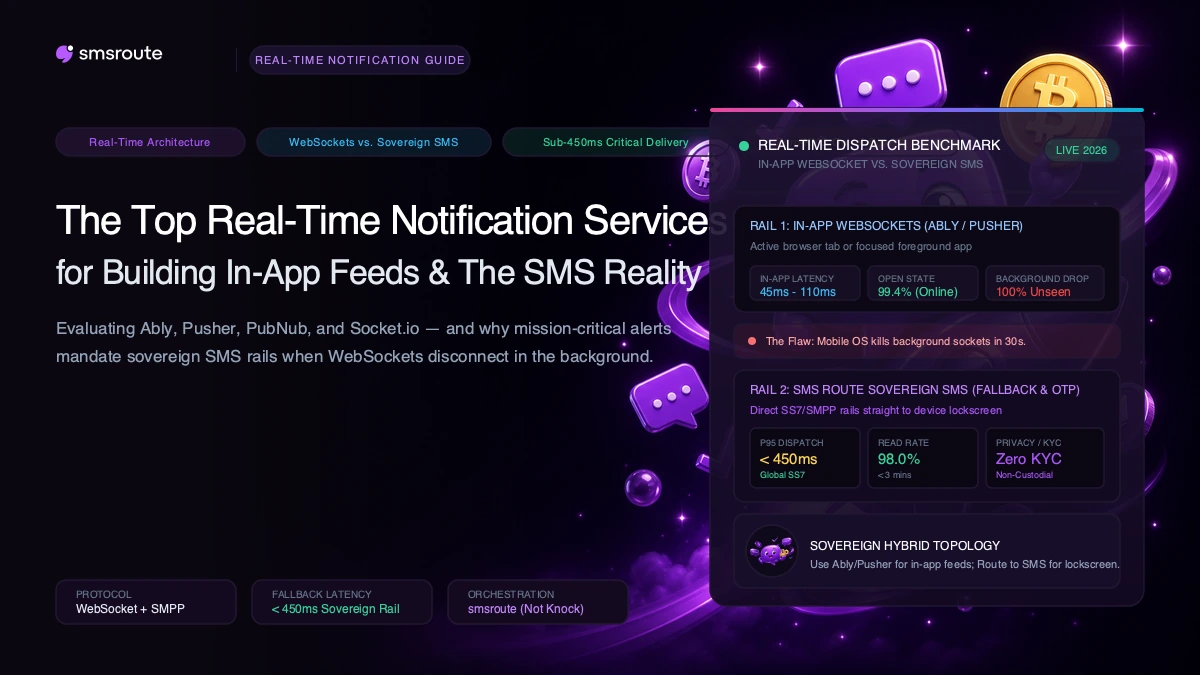
1. The Fallacy of In-App Real-Time Feeds: Why WebSockets Drop
Real-time, in-app notifications—typically delivered via an inbox, bell counter, or dynamic feed—have become standard in modern SaaS products. When users are actively interacting with your application in a focused browser tab or desktop client, instant WebSocket pushes allow you to stream document updates, team mentions, and collaborative state changes without page reloads.
However, building a production-grade notification architecture based solely on in-app real-time messaging is a fatal design flaw for any mission-critical application. The reason is simple: in-app notifications only exist when the user is actively using the app.
Both iOS (WebKit) and modern Android operating systems aggressively terminate idle TCP and WebSocket connections within 15 to 30 seconds after an app is backgrounded or the screen is locked. Browser tabs are routinely suspended by Chromium's Memory Saver, discarding open socket heartbeats. If a critical alert is sent over an in-app WebSocket while the device is sleeping, it is dropped into a dormant database queue that the user may not check for days.
Consider high-urgency business events:
- Security & 2FA OTPs: A user attempting to log into a crypto exchange or banking portal needs their verification code delivered within 3 seconds, regardless of whether their browser session is active.
- Infrastructure Incidents: An on-call engineer cannot afford to miss a Kubernetes node failure or database deadlock simply because their monitoring dashboard tab was closed.
- Financial Wire Verifications: Time-sensitive payment authorizations and AML compliance confirmations demand immediate out-of-band attention.
- Logistics & Dispatch: A delivery driver arrival or gate change alert must surface directly on the physical handset lockscreen.
For these mission-critical events, relying on WebSockets or browser push notifications (which suffer from a 75%+ opt-out rate globally) results in dropped communication, failed workflows, and damaged customer trust.
2. The Dual-Rail Hybrid Architecture: In-App + Sovereign SMS
To solve this dilemma, top engineering teams in 2026 deploy a Dual-Rail Hybrid Notification Topology:
- Rail 1 (Ephemeral In-App Feed): Powered by WebSocket brokers like Ably, Pusher, or self-hosted Socket.io. Used exclusively for low-to-medium urgency events (social mentions, comment threads, badge counters) while the user's presence state is verified as
ONLINE. - Rail 2 (Sovereign Out-of-Band SMS Rail): Powered by SMS Route via direct SS7 and SMPP 3.4 carrier interconnects. Triggered automatically for P0/P1 alerts, or when an in-app message remains unacknowledged after a strict timeout (e.g., 30–45 seconds).
SMS remains the only universal protocol that reaches every mobile handset on Earth within seconds without requiring app installation, background service workers, or network WebSocket handshakes. With an astonishing 98% open rate and 90% read within 3 minutes, sovereign SMS is the ultimate delivery guarantee.
3. Architecture Diagram: Real-Time In-App & Lockscreen Topology
The following technical architecture diagram illustrates how application microservices route real-time payloads through presence detection, directing low-urgency events to WebSocket brokers and high-urgency notifications directly to SMS Route sovereign carrier rails.

4. How to Evaluate Real-Time Notification Services in 2026
When architecting real-time notifications for developer-centric products, consider these six core technical dimensions:
- Delivery Latency (p95): For in-app WebSockets, sub-100ms global latency is expected. For out-of-band lockscreen alerts, the sovereign SMS gateway must dispatch directly into carrier SMSCs in under 450ms.
- Offline & Background Resilience: Does the system maintain deliverability when mobile clients enter sleep mode or terminate background threads? Can it survive network handoffs (Wi-Fi to 5G) without dropped frames?
- Protocol Standardization: Does the platform use open standards like RFC 6455 WebSockets and SMPP 3.4, or does it enforce vendor-locked proprietary protocols?
- Operational Overhead: Does your team need to maintain clustered Redis instances, sticky socket load balancers, and persistent connection pools, or is the transport fully managed?
- KYC & Onboarding Friction: Can your team provision production credentials instantly using non-custodial crypto payments (USDT, BTC, SOL), or are you subjected to weeks of enterprise paperwork and passport scans?
- Pricing Transparency: Does pricing scale predictably, or are there hidden multipliers based on concurrent connections (CCU), peak channels, and ingress bandwidth?
5. The Top Real-Time Notification Services Evaluated
Below is our engineering breakdown of the leading platforms powering real-time notification infrastructure in 2026.
SMS Route
SMS Route is the sovereign telecommunications gateway engineered specifically for developers who demand guaranteed, out-of-band delivery to user lockscreens. Rather than relying on ephemeral browser sockets or complex workflow middlewares, SMS Route communicates directly with Tier-1 carriers and Mobile Network Operators (MNOs) over SS7 signaling and direct SMPP 3.4 binds.
Whether serving as your primary delivery rail for 2FA security codes or acting as the automated failover rail when in-app WebSockets disconnect, SMS Route eliminates middleman delays. It is funded non-custodially with cryptocurrency, requires zero KYC passport uploads, and guarantees p95 dispatch latencies under 450ms worldwide.
Key Advantages
- Direct Tier-1 SS7 & SMPP 3.4 carrier interconnects.
- Universal lockscreen reach: 98% open rates, works on all 5.4B mobile phones.
- Sub-450ms p95 global delivery dispatch.
- Zero KYC verification: instant API keys, no passport vetting.
- Non-custodial crypto funding (USDT, USDC, BTC, SOL).
Considerations
- Designed for out-of-band and SMS notifications (does not render in-app DOM feeds).
- Per-message carrier billing instead of per-connection WebSocket pricing.
Pricing: Transparent pay-as-you-go per SMS segment based on global destination carrier rates, with no monthly platform fees, no minimum commitments, and no seat charges.
Ably
Ably is an enterprise-grade real-time data streaming platform built on a globally distributed edge network. Designed specifically for low-latency pub/sub messaging, Ably provides strong delivery guarantees including exact message ordering, idempotency, and a 99.999% uptime SLA.
For applications requiring high-concurrency in-app chat, live cursor positioning, and dynamic activity feeds, Ably is technically superior to legacy self-hosted brokers. Its SDKs handle connection state recovery seamlessly when clients switch networks.
Key Advantages
- 99.999% SLA across a global multi-region edge mesh.
- Guaranteed message ordering and message deduplication.
- Excellent token-based authentication and granular channel permissions.
- Built-in presence detection and connection state recovery.
Considerations
- Complex pricing model factoring in messages, peak connections, and bandwidth.
- Strictly in-app: zero telecom carrier rails for offline lockscreen reach.
- High costs at multi-million concurrent user scale.
Pricing: Free tier includes 6M monthly messages and 200 peak concurrent connections. Paid plans start at $29/mo, rapidly escalating into custom enterprise contracts for high-volume deployments.
Pusher Channels
Acquired by MessageBird (now Bird), Pusher Channels is one of the earliest hosted WebSocket solutions for developers. It pioneered the developer-friendly pub/sub model for WebSockets, offering lightweight client libraries for React, Vue, iOS, Android, and backend SDKs in Node, Go, and Python.
Pusher automatically falls back to HTTP long-polling when corporate firewalls block WebSocket traffic, making it a reliable choice for enterprise intranet environments. However, its architectural model routes channels through specific geographic clusters rather than a dynamic edge mesh.
Key Advantages
- Extremely simple developer onboarding and mature SDK ecosystem.
- Automatic HTTP long-polling fallback for restricted networks.
- Extensive documentation and boilerplate tutorials.
Considerations
- Cluster-bound architecture: cross-region latency can be high.
- Hard connection caps per plan tier trigger message drops on spikes.
- No native SMS or sovereign telecommunication failover capability.
Pricing: Free Sandbox tier includes 200k daily messages and 100 concurrent connections. Paid plans start at $49/mo (up to 1M messages/day, 500 connections) up to $499/mo for large deployments.
PubNub
PubNub operates an established global data stream network that powers real-time messaging, IoT device communication, and collaborative apps. Rather than using pure RFC 6455 WebSockets, PubNub relies on a proprietary transport layer optimized for high-concurrency broadcasting.
PubNub includes rich features such as presence tracking, serverless edge compute ("Functions"), channel multiplexing, and end-to-end encryption. However, its proprietary protocol can increase client bundle sizes and lock teams into PubNub's ecosystem.
Key Advantages
- Over 70 client SDKs spanning web, mobile, desktop, and embedded IoT.
- Built-in edge compute functions for on-the-fly payload transformation.
- Robust multi-channel subscriptions and user presence detection.
Considerations
- Proprietary protocol rather than standard WebSocket implementation.
- Monthly Active User (MAU) pricing can become prohibitively expensive.
- Does not bridge to telecom carrier lockscreens when mobile devices sleep.
Pricing: Free tier up to 200 monthly active users. Paid plans start at $49/mo with per-MAU scaling and enterprise contract requirements for high throughput.
Socket.io (Self-Hosted)
For engineering teams that refuse to use third-party managed brokers, Socket.io remains the dominant open-source real-time communication library for Node.js. It wraps standard WebSockets with automatic reconnection, packet buffering, and HTTP long-polling fallbacks.
While Socket.io eliminates per-message SaaS fees, it introduces substantial DevOps burden. Scaling beyond a single server requires configuring Redis Pub/Sub adapters, session-aware sticky load balancers, and monitoring clustered WebSocket connection limits under Linux kernel socket thresholds.
Key Advantages
- 100% open-source and free of vendor lock-in.
- Full control over message payload schemas, retention, and encryption.
- Zero per-message SaaS costs.
Considerations
- Heavy infrastructure maintenance: Redis adapters, sticky sessions, cluster autoscaling.
- Socket reconnect storms during rolling server deployments.
- Zero out-of-band capability: fails completely when mobile browser tabs suspend.
Pricing: Free and open-source software (MIT license). Infrastructure and DevOps staffing costs apply.
Knock (Orchestration Middleware)
Knock frequently markets itself as an all-in-one real-time notification service, providing pre-built in-app feed widgets, toast modals, and a visual workflow builder. It allows non-technical team members to edit message templates and schedule batching windows.
The Critical Distinction: Knock Does NOT Send SMS. Knock is merely an abstraction proxy layer. It does not own telecommunication interconnects, does not have SS7 signaling rails, and does not operate SMPP gateways. When you configure SMS inside Knock, Knock simply makes an API call to downstream aggregators like Twilio or Sinch—adding extra proxy latency, another point of failure, and significant SaaS markups.
Key Advantages
- Pre-built frontend UI components (inbox feeds, toasts, badges).
- Visual workflow builder for notification delays and digest batching.
- Preference management API for user unsubscribe toggles.
Considerations
- Does not send SMS: requires separate downstream gateway accounts.
- Adds proxy latency to time-critical dispatches.
- Expensive enterprise pricing tiers for production volume.
- Proprietary workflow lock-in: difficult to migrate off.
Pricing: Free tier up to 10k notifications/month. Starter plan at $250/mo (up to 50k notifications). High volume requires custom Enterprise contracts.
6. Direct Side-by-Side Comparison Matrix
The table below provides a comprehensive engineering comparison of real-time in-app notification services versus sovereign SMS telecom rails.
| Provider | Primary Rail | p95 Latency | Offline Delivery | Transport Protocol | KYC Friction | Payment Options |
|---|---|---|---|---|---|---|
| SMS Route | Lockscreen SMS | < 450ms | 100% (Native Handset) | SS7 / SMPP 3.4 / REST | Zero KYC | Crypto (USDT, BTC, SOL) |
| Ably | In-App WebSocket | < 65ms | 0% (Drops on sleep) | WSS / TLS 1.3 | Standard SaaS | Credit Card / Invoicing |
| Pusher Channels | In-App WebSocket | < 100ms | 0% (Drops on sleep) | WSS / HTTP Fallback | Standard SaaS | Credit Card |
| PubNub | In-App Stream | < 85ms | 0% (Drops on sleep) | Proprietary DSN | Standard SaaS | Credit Card / Invoicing |
| Socket.io | Self-Hosted Socket | < 50ms | 0% (Drops on sleep) | WSS / Engine.io | None (Self-hosted) | Self-hosted Infra |
| Knock | Orchestration Proxy | 250ms - 800ms | Delegated downstream | HTTPS REST / Proxied | Standard SaaS | Credit Card / Enterprise |
7. Production Code: Real-Time WebSocket Presence with SMS Fallback
Here is a complete, production-ready TypeScript pattern demonstrating how modern architectures manage real-time notifications. It attempts delivery via an in-app WebSocket channel while checking the user's presence state. If the user is offline or fails to acknowledge a critical alert within 30 seconds, it immediately routes to SMS Route via sovereign SMS:
import { createHash } from "crypto";

interface NotificationPayload {
  userId: string;
  phoneNumber: string;
  title: string;
  message: string;
  priority: "P0_CRITICAL" | "P1_HIGH" | "P2_STANDARD";
}

interface PresenceEngine {
  isUserOnline(userId: string): Promise<boolean>;
  sendInApp(userId: string, payload: any): Promise<void>;
  waitForAck(userId: string, eventId: string, timeoutMs: number): Promise<boolean>;
}

export class HybridNotificationDispatcher {
  private smsRouteApiKey: string;
  private smsRouteApiUrl = "https://api.smsroute.com/v1/sms/send";
  private presence: PresenceEngine;

  constructor(smsRouteApiKey: string, presence: PresenceEngine) {
    this.smsRouteApiKey = smsRouteApiKey;
    this.presence = presence;
  }

  async dispatch(payload: NotificationPayload): Promise<{ deliveredVia: "IN_APP" | "SOVEREIGN_SMS" }> {
    const eventId = createHash("sha256")
      .update(`${payload.userId}-${Date.now()}`)
      .digest("hex")
      .substring(0, 16);

    const isOnline = await this.presence.isUserOnline(payload.userId);

    // If P0 critical, or user is offline/unfocused, trigger immediate SMS Route dispatch
    if (payload.priority === "P0_CRITICAL" || !isOnline) {
      console.log(`[SMS-ROUTE] User ${payload.userId} is OFFLINE or event is P0. Dispatching sovereign SMS.`);
      await this.sendSovereignSMS(payload.phoneNumber, `${payload.title}: ${payload.message}`);
      return { deliveredVia: "SOVEREIGN_SMS" };
    }

    // Attempt delivery via active in-app WebSocket feed
    await this.presence.sendInApp(payload.userId, {
      eventId,
      title: payload.title,
      message: payload.message,
    });

    // Wait for in-app acknowledgment heartbeat (30-second SLA timeout)
    const acknowledged = await this.presence.waitForAck(payload.userId, eventId, 30_000);

    if (!acknowledged) {
      console.warn(`[SMS-ROUTE] In-app notification ${eventId} unacknowledged after 30s. Triggering SMS fallback.`);
      await this.sendSovereignSMS(payload.phoneNumber, `[ALERT] ${payload.title}: ${payload.message}`);
      return { deliveredVia: "SOVEREIGN_SMS" };
    }

    return { deliveredVia: "IN_APP" };
  }

  private async sendSovereignSMS(to: string, text: string): Promise<void> {
    const response = await fetch(this.smsRouteApiUrl, {
      method: "POST",
      headers: {
        "Content-Type": "application/json",
        "Authorization": `Bearer ${this.smsRouteApiKey}`,
      },
      body: JSON.stringify({
        to,
        message: text,
        routing: "DIRECT_SS7_FASTPATH",
      }),
    });

    if (!response.ok) {
      const err = await response.text();
      throw new Error(`SMS Route dispatch failed HTTP ${response.status}: ${err}`);
    }
  }
}
8. Frequently Asked Questions (FAQ)
Why do in-app real-time notifications fail when users are mobile or offline?
In-app notifications rely on persistent WebSocket or HTTP long-polling connections. Modern mobile operating systems (iOS and Android) aggressively terminate background WebSocket connections within 30 seconds to conserve battery life and radio resources. When a browser tab is hidden or the screen is locked, in-app sockets disconnect, leaving critical alerts unread until the user manually re-opens the app.
How does Knock differ from direct SMS providers like SMS Route?
Knock is an orchestration SaaS and workflow builder that manages notification templates and routing rules, but Knock does not operate telecommunication infrastructure and does not send SMS directly. Knock delegates SMS delivery to downstream aggregators, incurring proxy latency, markup fees, and carrier KYC overhead. In contrast, SMS Route is a sovereign SMS gateway with direct SS7 and SMPP carrier interconnects, delivering messages directly to handset lockscreens in under 450ms with zero KYC requirements.
What is the recommended architecture for mission-critical notifications?
The industry gold standard is a Dual-Rail Hybrid Architecture: use an in-app WebSocket service (such as Ably or Pusher) while the user's presence state is active in the application, paired with an automated acknowledgment timeout (typically 30 to 45 seconds). If the user does not acknowledge or if their WebSocket connection is offline, the backend automatically dispatches an out-of-band sovereign SMS alert via SMS Route.
How do Pusher Channels, Ably, and PubNub compare for in-app messaging?
Pusher Channels is easiest to integrate with straightforward client SDKs but suffers from regional cluster boundaries. Ably provides an ultra-reliable global edge network with guaranteed message ordering and token authentication, though its pay-as-you-go pricing can escalate rapidly. PubNub provides extensive multi-platform SDKs and serverless edge functions but relies on a proprietary transport protocol rather than open WebSockets.
Why should developers use SMS Route for out-of-band fallback alerts?
SMS Route provides sovereign telecommunications rails with sub-450ms global p95 delivery latency, zero-KYC instant provisioning, non-custodial cryptocurrency funding (USDT, BTC, SOL), and direct SMPP 3.4/REST API access. This guarantees that urgent security codes, transaction confirmations, and server alerts land on user lockscreens worldwide without bureaucratic delays.
Build Resilient Real-Time Notification Rails with SMS Route
Never let an in-app WebSocket drop silence a critical security code or transaction alert. Connect directly to sovereign SS7 carrier rails in under 60 seconds with zero KYC.
Start Dispatching with SMS Route →