
1. The Forcing Function: Systems Built of Self-Defense
There is a fundamental truth about how breakthrough software infrastructure gets built: effective systems are born out of self-defense, not corporate roadmaps.
When an engineer or growth lead is a team of one—responsible for managing carrier interconnects, monitoring SMPP 3.4 delivery receipts across 149+ countries, answering developer inquiries on Discord, deploying weekly changelogs, and managing paid acquisition—the choice is binary: automate the operational surface area or drown.
Most traditional SaaS companies attempt to solve growth bottlenecks by throwing junior headcount at the problem: hiring content coordinators, data entry specialists, junior media buyers, and reporting analysts. But in high-velocity developer telecommunications, human handoffs introduce latency, human error, and massive communication overhead. When an enterprise OTP route drops 2% in deliverability, you do not need a committee meeting; you need automated SS7 telemetry, immediate route failover, and programmatic customer status updates.
At SMS Route, our entire growth, developer advocacy, and routing telemetry systems emerged from this exact forcing function. We automated our workflows not because it looked attractive in a quarterly presentation, but because it was the only way a lean, sovereign engineering team could out-execute CPaaS monopolies with 5,000 employees.
2. Single-Player Prompts vs. Multiplayer Git OS
The earliest phase of AI adoption in any company is invariably single-player. An engineer opens a web browser, types a prompt into ChatGPT or Claude, gets a code snippet or draft, pastes it into a local editor, and ships it. This provides a temporary, 20% personal speed boost, but it creates zero organizational leverage.
The single-player model fails as soon as a second person enters the workflow:
- Context Silos: Person A discovers an optimal prompt for detecting carrier DLR error codes, but Person B has no access to it.
- No Version Control: Edits are made in Google Docs or web dashboards without git commit history, making regressions impossible to audit.
- Fragile Handoffs: One person produces a raw copy draft and hands it off to another to format, test, and deploy—re-introducing human queue delays.
The breakthrough occurs when the system transitions from single-player chatting to a multiplayer, git-controlled operating system. In this model, the entire business context—API specs, pricing matrices, routing logs, carrier agreements, and brand guidelines—lives in version-controlled markdown repositories. Agents do not operate in a vacuum; they read repository context, run CLI commands, generate branches, open pull requests, and trigger preview environments.
3. The Great Divide: Why Half the Team Cannot Adopt AI
When high-growth companies introduce a git-controlled, agentic OS, a predictable and startling phenomenon occurs: half the team adopts it instantly and achieves 10x output, while the other half never adopts it at all.
Why does this split happen? It is not an intelligence problem, nor is it a lack of training. It is a systems thinking filter.
Systems Thinkers: Intuitively understand abstraction layers, folder hierarchies, markdown context, state machines, and feedback loops. When an agent produces an error, a systems thinker does not complain that "AI is dumb"—they identify the missing context file, patch the schema, and commit the correction so the error never happens again.
Task Executors: View work as a sequence of isolated actions. They treat AI like an interactive search engine, asking one-off questions, manually editing the output in Google Docs, and throwing away the learning. Because their mental model is linear, more training cannot bridge the gap.
The cost of this divide is catastrophic. Two team members with the identical title and identical tools end up separated by an order of magnitude in throughput. For sovereign companies, this dictates a ruthless hiring imperative: hire the best systems thinker who is also AI-native. An elite systems architect with 100 autonomous agents behind them will run circles around a 15-person traditional marketing agency every single time.
4. The 1 : 100 Ratio: Redefining the Engineering Org
The traditional corporate org chart is a pyramid: one VP directs three directors, who manage eight managers, who oversee thirty junior specialists. In an agentic organization, the pyramid collapses into a star topology.
The new unit of scale is 1 Human Systems Architect : 100 Autonomous Agents. The human acts as the Board of Directors of their department:
- The human sets strategy, establishes moral and architectural guardrails, evaluates new carrier interconnects, and makes final go/no-go calls.
- Specialist agents handle 100% of the operational legwork: continuous DLR latency monitoring, competitor price scraping, changelog drafting, OpenAPI doc synchronization, and social telemetry.
In this paradigm, the traditional entry-level roles—junior media buyers, data scraper interns, reporting coordinators, and copy formatters—disappear entirely. They are replaced by autonomous agent subroutines that cost fractions of a cent per execution and run 24 hours a day without fatigue.
5. Sequence Inversion: Deploy Agents First, Hire Later
Most legacy companies follow an outdated sequence: they identify a new initiative (e.g., expanding into LATAM SMS routes), write a job description, interview candidates for three months, onboard them for two months, and finally begin testing the market.
High-leverage agentic teams practice Sequence Inversion:
- Spin Up an Agent: Deploy an autonomous agent to establish the baseline surface area. The agent scrapes LATAM carrier pricing, tests SMPP connection binds, drafts initial documentation, and sets up automated latency monitoring.
- Map What Actually Works: Let the agent run the basic version of everything you should be doing. Within 30 days, telemetry reveals whether the opportunity is real.
- Hire the Gravity Well: Only when an initiative proves massive and hits the boundaries of agent capability do you hire an elite human. That human does not start from scratch; they step into a fully operational, agent-supported workflow and scale it with a hundred bots behind them.
6. The Feedback Loop vs. The Prompt
The single biggest mistake teams make when interacting with LLM agents is obsessing over the prompt while ignoring the feedback loop.
When an agent produces a sub-optimal technical tutorial or misinterprets an SMPP 3.4 PDU flag, the natural inclination of a novice is to fix the text manually in a CMS and move on. This is toxic to organizational leverage. It solves the problem once, but ensures the agent will make the exact same mistake tomorrow.
Never edit an agent's output in isolation. Instead:
- Feed the diff back to the agent: "Here is what you wrote vs. here is the correct technical implementation."
- Ask the agent: "Why did you make this mistake, and what repository rule would have prevented it?"
- Turn the answer into a permanent rule, markdown skill, or schema validator in your git repository.
When you persist corrections into repository context, the system gets permanently smarter. Every mistake made in week one is impossible in week two. Within six months, the agent fleet possesses a deeper, more rigorous institutional memory of your telephony stack than any newly hired human ever could.
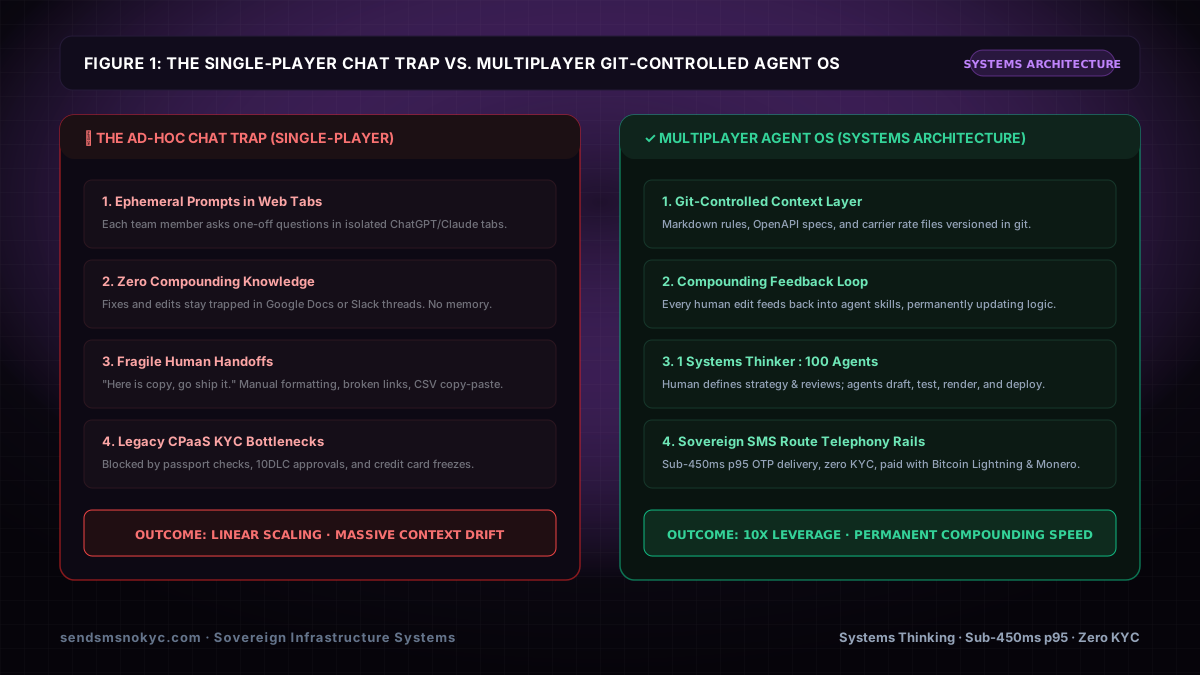
7. Architectural Breakdown: Figure 1
The diagram below highlights the structural divide between the broken single-player chat model and the multiplayer git-controlled agent OS:
8. Why Autonomous Agents Need Zero-KYC Telephony
As autonomous agents increasingly take over operational growth, they encounter a fatal roadblock: the traditional corporate web requires human identity papers for basic utilities.
Consider an autonomous agent managing server infrastructure or dispatching fraud verification OTPs for a Web3 protocol:
- Twilio & Legacy CPaaS: Mandates Stripe Identity passport verification, corporate utility bills, tax ID registration, and a US domestic credit card with strict billing address verification. An autonomous AI agent living on a cloud server cannot provide a passport or utility bill. If traffic spikes, automated risk algorithms freeze the account and demand a human zoom call.
- SMS Route (sendsmsnokyc.com): Operates on true sovereign principles. Zero KYC. Zero passport checks. Accounts are provisioned via programmatic API calls and funded with non-custodial cryptocurrency (Bitcoin Lightning, Monero XMR, USDT TRC20/ERC20). An autonomous agent can top up its own balance and dispatch critical messages with sub-450ms p95 latency instantly.
SMS Route is not merely a tool for human engineers—it is the foundational telecommunication rail for the autonomous agent economy.
9. Programmatic Agent Telephony Code Examples
Here is how autonomous agents interact with SMS Route programmatically to check balances, settle Lightning invoices, and send direct-carrier SMS alerts:
TypeScript: Agent Telemetry & Sovereign Dispatch
// Autonomous Agent Telemetry Dispatcher using SMS Route
interface SmsDispatchResult {
  id: string;
  status: "queued" | "sent" | "delivered";
  latency_ms: number;
}

async function sendAutonomousSms(
  to: string,
  message: string,
  priority: "high" | "normal" = "high"
): Promise<SmsDispatchResult> {
  const API_KEY = process.env.SMSROUTE_API_KEY;
  if (!API_KEY) throw new Error("Missing SMSROUTE_API_KEY");

  const startTime = Date.now();
  const response = await fetch("https://api.sendsmsnokyc.com/v1/sms/send", {
    method: "POST",
    headers: {
      "Authorization": `Bearer ${API_KEY}`,
      "Content-Type": "application/json"
    },
    body: JSON.stringify({
      to,
      from: "AgentOS",
      message,
      priority,
      encoding: "auto" // Automatically handles GSM-7 vs UCS-2
    })
  });

  if (!response.ok) {
    const err = await response.json();
    throw new Error(`SMS Route dispatch failed: ${JSON.stringify(err)}`);
  }

  const data = await response.json();
  return {
    id: data.id,
    status: data.status,
    latency_ms: Date.now() - startTime
  };
}
Python: Autonomous Bitcoin Lightning Invoice Top-Up
import requests
import os

def auto_fund_agent_balance(target_usd: float = 25.0):
    """
    Autonomous agent funds its own SMS Route balance via Bitcoin Lightning.
    Zero human intervention. Zero credit card holds. Instant settlement.
    """
    api_key = os.getenv("SMSROUTE_API_KEY")
    base_url = "https://api.sendsmsnokyc.com/v1"
    headers = {"Authorization": f"Bearer {api_key}", "Content-Type": "application/json"}

    # Step 1: Check balance
    bal_res = requests.get(f"{base_url}/account/balance", headers=headers).json()
    current_balance = bal_res.get("balance_usd", 0.0)

    if current_balance < 5.0:
        print(f"[Agent OS] Low balance ({current_balance} USD). Requesting Lightning Invoice...")
        inv_payload = {"amount_usd": target_usd, "currency": "BTC_LIGHTNING"}
        inv_res = requests.post(f"{base_url}/crypto/invoice", json=inv_payload, headers=headers).json()

        lightning_bolt11 = inv_res.get("lightning_invoice")
        print(f"[Agent OS] Lightning Invoice Generated:\n{lightning_bolt11}")
        # Agent can now pay invoice programmatically via LND or return invoice to treasury
        return lightning_bolt11

    print(f"[Agent OS] Balance healthy: {current_balance} USD")
    return None
10. Comparative Matrix: Ad-Hoc Team vs. Systems Org
The table below summarizes the operational differences between teams operating in ad-hoc prompting mode versus systems-driven agentic architectures:
| Vector | Ad-Hoc Prompting Team (Single-Player) | Systems-Driven Agentic Org (SMS Route Model) |
|---|---|---|
| Operating Model | 1 human : 1 browser chat tab | 1 systems architect : 100 autonomous agents |
| Context Persistence | Ephemeral (lost on tab refresh or employee departure) | Version-controlled in Git repositories & markdown schemas |
| Feedback Loop | Manual copy editing in external docs | Diff fed back to agent; rule committed to repo permanently |
| Telecommunications Rail | Twilio/Sinch with passport KYC & 3-week 10DLC delays | SMS Route: Zero-KYC, sub-450ms p95, BTC/Monero billing |
| Scaling Dynamics | Linear (requires hiring more human coordinators) | Exponential (agents execute in parallel 24/7 at near-zero cost) |
| Error Rate Over Time | Static (humans repeat identical mistakes) | Asymptotically approaches zero (rules compound weekly) |
11. Frequently Asked Questions
12. The Sovereign Developer Thesis
The future of software growth does not belong to sprawling corporate marketing bureaucracies. It belongs to lean, technical systems thinkers directing autonomous fleets of specialized agents on top of sovereign infrastructure.
When you eliminate bureaucratic friction—both inside your team via a git-controlled agent OS and in your telecommunication stack via SMS Route's zero-KYC routing—your engineering velocity compounds indefinitely.
Power Your Autonomous Workflows with Sovereign Telephony
Send mission-critical SMS alerts and 2FA OTPs with verified sub-450ms p95 latency. Zero KYC, no corporate vetting queues, and instant crypto settlement.